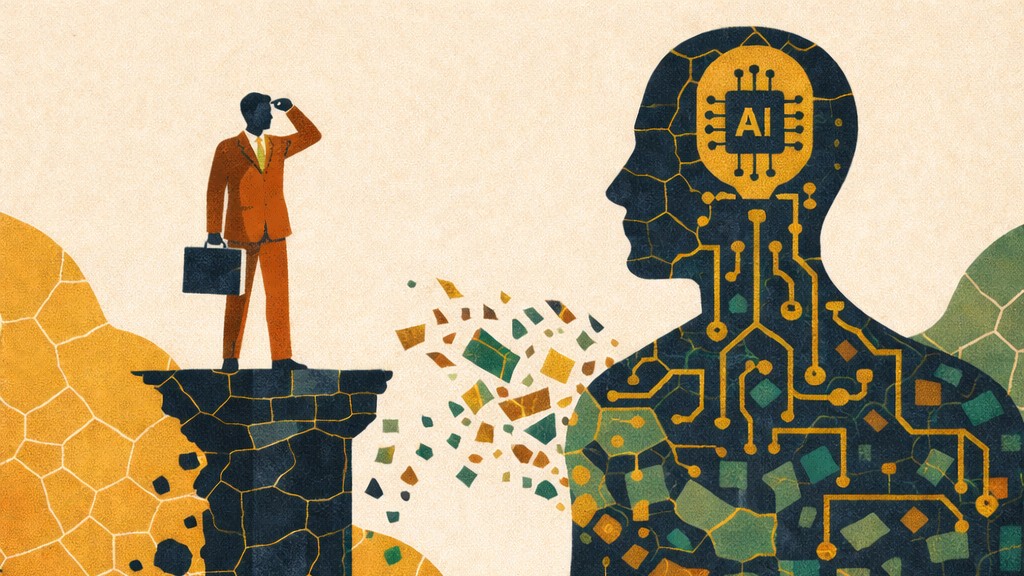
In boardrooms across the globe, the reaction to Artificial Intelligence follows a predictable, yet dangerous, spectrum. At one end, we see the "Ostrich" — the leader in total denial, certain that AI is a passing fad or irrelevant to their niche. At the other, we see "Panic Mode" — a frantic, uncoordinated rush to "do something with AI" before the competition does. Both reactions stem from the same fundamental misunderstanding: viewing AI as a technical problem to be solved by a software vendor.
As Professor Richard — entrepreneur, investor, and academic director of the Executive MBA program at ESSEC — recently explored in a masterclass on adaptive leadership, navigating the AI revolution is not a technical hurdle. It is an adaptive challenge. The "thick fog" of uncertainty we currently face cannot be cleared by a better algorithm. It requires us to stop looking for better tools and start building better systems.
The Typing Pool Trap: The Hidden Cost of "Editing"
When we discuss AI, we often fall into the "Typing Pool Trap," focusing narrowly on whether a technology "automates" or "augments" a specific task. To escape this, we must look at the history of the word processor.
In the 1950s and 60s, offices were dominated by specialized "typing pools." When computers arrived, the role of the "typist" vanished. Crucially, the task of typing did not disappear — most of us are typing more than ever. The role became obsolete because the technology changed the fundamental cost-structure of the entire system. In the era of the typewriter, the cost of a mistake was high; it required physical correction or a total restart. The word processor dropped the cost of editing to zero.
When a fundamental constraint (like the cost of editing or coordination) evaporates, the entire system must be redesigned. Focusing only on "task efficiency" is a distraction from the systemic shift occurring beneath our feet.
"The deeper impacts of technology, when they occur, are rarely at the task level, but tend to happen at the system level."
Redesigning the Coordination Layer: From GM to Shein
The difference between a "tool upgrade" and a "systemic evolution" is best seen in the historical rivalry between General Motors and Toyota. In the 1970s, GM spent billions attempting to replace human workers with robots, essentially trying to automate an old, flawed system. Meanwhile, Toyota focused on the "coordination layer."
They introduced the Andon Cord — a tool that allowed any human on the production line to stop the entire process if they saw an anomaly. This wasn't just a technical fix; it was a systemic shift that moved power from the "heroic expert" at the top to the collective intelligence of the workers on the line.
Today, the fashion giant Shein has applied this systemic thinking to retail. While traditional giants like Zara or H&M rely on a slow, manual, multi-stakeholder process to plan seasonal collections, Shein has implemented an "Algorithm-as-Coordinator" model:
- Real-Time Trend Detection: Algorithms monitor browsing habits and real-time data to identify micro-trends instantly.
- Automated Micro-Batching: The system automatically coordinates with a vast network of designers and factories to produce tiny batches of new items.
- Continuous Feedback Loops: If a batch sells, the system automatically triggers more production; if not, it kills the line immediately.
Shein didn't just speed up the old fashion cycle; they replaced a manual coordination layer with a real-time system that bypasses traditional planning entirely.
The Death of the "Heroic Leader"
For decades, we have been trained in the "Heroic Leadership" model. In this framework, the leader provides protection, direction, and order. We are expected to be the experts with all the answers. However, this model is a trap — one set by both the leader's ego and the team's fear. During times of "thick fog," followers instinctively demand protection and certainty, but a leader who pretends to have the answers in an AI-driven world is a liability.
We must shift to Adaptive Leadership. In this model, the leader is not an expert, but a mobilizer. Your new task is to keep your people in a state of "productive discomfort," helping the collective figure out solutions rather than pointing the way from a position of false certainty. This shift is psychologically grueling because it requires you to admit you don't know the way forward — but in a world of infinite AI-generated possibilities, "not knowing" is the only honest starting point.
The Three Human Skills AI Can't Replicate
As knowledge becomes cheap and abundant, the value of being a "knowledge-bearer" has collapsed. To lead, we must move beyond expertise and cultivate three specific skills that AI cannot replicate:
-
Curiosity (The Search for the Right Question): AI can explore any direction you point it toward, but it cannot decide where your organization's attention should be prioritized. The human skill is determining what actually matters.
-
Curation (The Expert Filter): AI will produce an infinite number of answers. Curation is the ability to use your hard-earned expertise to connect dots, filter the "hallucinations" or mediocre options, and determine which answer fits your specific organizational context. Expertise is not dead; it has evolved into the ultimate filter.
-
Commitment (Taking the Hit): AI cannot take risks. It cannot commit resources or "take the hit" if a project fails. Only humans can turn a theoretical answer into a high-stakes decision. Action requires skin in the game; AI has none.
Leadership as Biology: Dismantling the DNA
Organizational adaptation mirrors evolution. To survive the AI revolution, we must view our leadership through a biological lens:
- Discarding: This is the hardest step. Adaptation is not just about growth; it is about loss. You must be willing to "dismantle the DNA" — the legacy processes and habits — that no longer serve the environment.
- Preserving: You must identify and protect the core foundations that remain valuable despite the technological shift.
- Experimenting: Every new initiative should be treated as a genetic experiment. We must launch, observe, and see what survives in the new reality.
The "automation trap" occurs when we stack AI on top of old ways of working because we are afraid to kill our legacy processes. True adaptation requires us to accept that some of our "DNA" must die for the organization to live.
Embracing the Chameleon: The Power of Paradox
The modern leader must be a "chameleon," capable of holding conflicting realities simultaneously. To succeed, you must balance these simultaneous paradoxes:
- Confident yet Humble: Confident in the process of mobilization, but humble regarding the answers.
- Decisive yet Reflective: Make bold moves while constantly tracking new data and being willing to adjust course mid-stream.
- Grounded yet Creative: Rooted in the harsh reality of the present while maintaining the imagination to envision an entirely new system.
The Path Forward: The Asian Advantage
While the shift from technical expert to adaptive leader is a global challenge, there is a distinct cultural advantage in Asia. The intuitive capacity to manage "opposite forces" and navigate ambiguity — the Yin and Yang of strategic leadership — is a foundational cultural strength. This comfort with paradox is exactly what the AI era demands.
Ultimately, the AI revolution is not an invitation to do what you've always done, only faster. It is a mandate to redesign how you work, how you coordinate, and how you lead.
As a leader, are you trying to find a better tool, or are you ready to build a better system?
Based on a masterclass on adaptive leadership by Professor Richard, entrepreneur, investor, and academic director of the Executive MBA program at ESSEC.